
How Much to Spend on Clothes in 2026
- Sheena Hemens
- Jul 17
- 7 min read


Winter has properly arrived here in Ōtautahi Christchurch, and I have spent the last few weeks in changing rooms all over town with clients. In amongst all the trying on, many clients struggle to give themselves permission to spend money on themselves - especially on their wardrobes!
So let's talk about it. After 20 years as a stylist, I think I can take some of the mystery out of how much to spend on clothes in 2026, how to set a clothing budget you can actually live with, and how to do it all without the hand-wringing.
Because here is the thing. Clothing is deeply psychological. It’s visible in a way a new blender never will be, so we get self-conscious, we worry we are being judged, and that puts us off buying the very things we would love. Worth unpacking, I think.
Why spending money on clothes feels so hard
Over the years I have heard every reason under the sun, and they tend to boil down to five sticking points:-
The visible mistake. Clothes are out in the open. Get it wrong and everyone can see. So some people buy nothing at all, which is its own sort of mistake.
Sizing and fit. Sizes are all over the place from brand to brand, and an item that will not do up can drag up every feeling we have ever had about our bodies. Let me say this plainly: ignore the label inside the garment. I own size 8s, 10s and 12s, and they all fit me beautifully. It is about how a thing sits and feels on you, and nothing else. If it does not fit, the garment is wrong, not you. Hang it back up and move on.
Cost per wear. A cheap top can lose its shape in a fortnight, while a better made piece lasts for years. That makes the cheap option the expensive one in the long run. But that maths can tip people into buying nothing, and then we just wear the same tired things and miss out on all the joy.
Utility versus self-expression. Clothes keep us warm and decent, yes, but they are also bound up with who we are. People struggle to justify a price when they decide a garment is not "practical" enough. My answer is to stop pitting the two against each other and link them instead: choose pieces that are both wearable and unmistakably you.
The frugality mindset. For a lot of us, spending on something for ourselves is hard - we are so tuned to doing things for others. But clothing is not a luxury, it is a necessity. We have to stay warm, dry and modest. So we may as well be thoroughly delighted with ourselves while we are at it.
The 70/30 wardrobe rule (and why I lean 80/20)
Here is the best place to start, and it takes the panic out of the whole thing. It is called the 70/30 wardrobe rule.


Roughly 70% of your wardrobe should be pieces you will genuinely wear most of the time. Your workhorses. Sweaters, jeans, shirts, the things that turn up again and again through a season. And no, that does not have to mean a white shirt, blue jeans and a black blazer, unless, of course, that is your vibe.
The other 30% are your special, creative, occasion pieces. Mine include a gold Sass & Bide set that is perfect for an event and no use whatsoever on a Tuesday. I also keep a few formal dresses, all in colours that work for me.

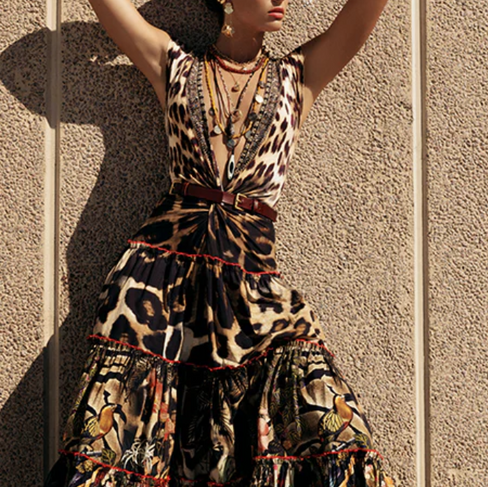


For me though, it is closer to 80/20, because I like my good things to actually get worn rather than sulking on the rail. For example, I have a Camilla skirt I adore that was always a touch too long, I kept tripping and so left it hanging there unworn. This morning I finally handed it to my husband David and asked him to chop a bit off the bottom so I can hem it. Just like that, it moves out of the neglected 30% and into the worn 70%. And if you love it - isn’t that where it belongs?
How much should you spend on clothes? The 5% rule
Right, the actual money. When I trained as a stylist 20 years ago, the guidance was to allocate around 5% of your after-tax income to clothing, and 5% to 10% to your overall personal appearance once you fold in hair, nails, facials and the rest.
Let me make that real. To make the maths easy, let's say you earn $100,000 a year. Take roughly 30% off for tax and you are on about $70,000 net. Ten percent of that is $7,000, and if we halve it for clothing alone, that is around $3,500 a year. You might split it across the seasons, and I would put a little more into winter, when boots and coats cost more, than into lighter summer pieces.
Five percent will feel like a lot to some of you and not enough to others, and that is completely fine. This is a guide, not a rule carved in stone. If you are on the careful side, 5% is plenty.
A few tips on how to spend on clothing:
Save a fixed amount. Pop $50 to $150 a week into a separate account, so shopping time never feels like a shock to the system.
Shop twice a year. This is what most of my clients do. We save, then we go out together, look at what worked and what did not last time, and build from there.
Starting from scratch? If you have not bought for yourself in years, begin with a minimum of around $1,000, and stretch to $2,000 in winter if you can, because shoes and boots that actually last will run you $250 to $300 a pair.
And please hear me on this. You can look absolutely fabulous without spending a fortune. I took a lovely Auckland client to Sylvia Park recently with $750 to her name, two small children and a completely changed life, and we came in bang on budget with a wardrobe she looked wonderful in. It is not about the size of the number. It is about spending it well.
The rule of five: your seasonal capsule wardrobe
If percentages make your eyes glaze over, try this instead, because it is honestly how I shop. It is the rule of five: limit yourself to five clothing items per season and you build a curated capsule wardrobe almost by accident, at about ten considered pieces a year.
Here is my winter five, more or less. A little Zara haul back in late summer got me some jeans, a couple of tops and a blazer for around $300. Then a matching two-piece from Cue, a piece from Alamai that cost a bit more, and the Ruby Matilda Cardi I had been eyeing for a whole year before I finally caved. I am so glad I did, because I have barely taken it off.

I may still add a winter coat, but only if it is something I truly love in a colour that works for me. And I am currently knitting myself a chocolate brown cardigan, purely because I could not find one I liked anywhere. That is the spirit of the rule of five: fewer pieces, chosen on purpose, worn to death in the best possible way.
How to spend less on clothes without looking like it
You do not have to pay full price to dress beautifully. A few of my favourite ways to stretch a clothing budget:
Wait for the sale. My embellished Alamai shirt was not for me at full price, so I bided my time, caught it in the sale, and have loved it for a couple of years since.
Buy second hand. I take everything I no longer wear to a Recycle Boutique and build up a credit, which, by the way, my daughters then merrily spend on themselves. Cheeky, but I have made peace with it. Have a look at Save Mart, the Salvation Army stores and consignment too. My son Zack turned up this week in a Ksubi set he found at a menswear consignment store, label still on. A chip off the old block.
Try the apps. Trade Me and Depop are brilliant for buying and selling. Personally, I am terrible at selling online, but plenty of my clients do wonderfully out of it.
Invest in the basics. Really good jeans in a couple of colourways that suit you, and shoes and boots that last more than one season, will carry your whole wardrobe.
Save your splurge for trends you will actually wear. Keep any fast fashion to that top 30%, and even then, I am always looking for pieces a client can wear for at least five years.
Steph’s Top Tips
If you take nothing else away, take this:
Aim for around 5% of your after-tax income on clothing, 5% to 10% on your appearance overall, and adjust to suit your life.
Use the 70/30 rule, or my enhanced 80/20: most of your wardrobe is wearable everywhere, a smaller slice saved for the fun and the fancy.
Try the rule of five each season to build a capsule wardrobe without the overwhelm.
Thrift, wait for sales, sell what you do not wear, and put your money into the basics.
Clothing is not something to feel guilty about. It keeps you warm and dry, and it can also let you be completely, joyfully yourself. So go forth, spend a little on you, and enjoy it.
Good luck with your winter shopping. If you would like a hand, you know where I am: brightred.co.nz. I could be your shopping wing-woman, and I would love to help you get more bang for your buck.
Kia kaha, everyone. Keep warm, keep dry.


Comments